What Is Home Energy Management in the Smart Grid (and How Does It Work)?
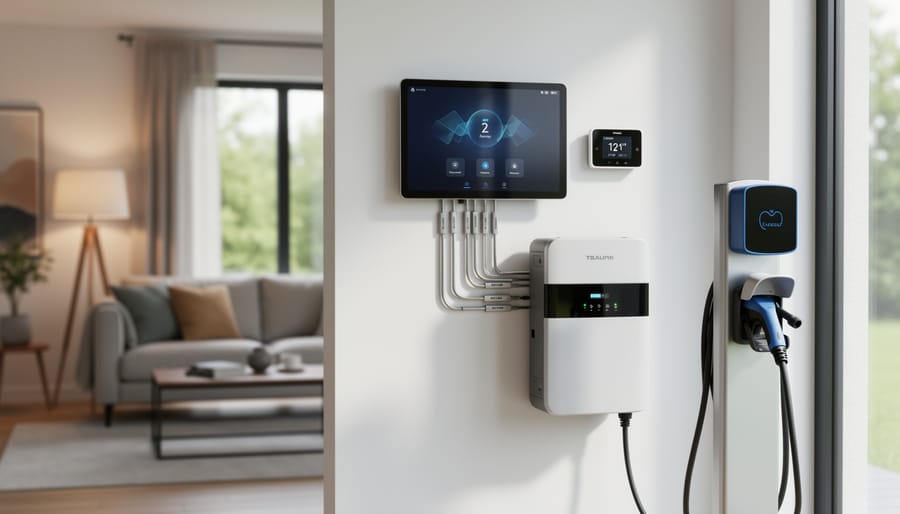
A home energy management system within a smart grid is a residential technology platform that monitors, controls, and optimizes household electricity consumption in real time while coordinating with utility grid signals to balance supply, demand, and pricing. These systems integrate smart thermostats, connected appliances, battery storage, rooftop solar inverters, and electric vehicle chargers into a unified control layer that responds dynamically to grid conditions, time-of-use tariffs, and renewable energy availability.
The convergence of distributed energy resources and two-way grid communication has transformed homes from passive consumers into active participants in grid stability. By 2026, more than 35 percent of new residential installations in North America include some form of automated demand response capability, driven by utility incentive programs, falling hardware costs, and regulatory mandates for grid flexibility. Home energy management systems deliver measurable value across three dimensions: reduced electricity bills through load shifting and peak avoidance, enhanced grid reliability by curtailing demand during stress events, and increased renewable integration by aligning consumption with solar and wind generation patterns.
This article examines the operational mechanics of residential energy management within smart grid architecture, the core hardware and software components that enable automated control, the range of applications from HVAC optimization to behind-the-meter energy trading, and the technical and regulatory challenges that still constrain widespread deployment. For homeowners and energy professionals alike, understanding how these systems function and where the technology is headed is essential for navigating the transition to a decentralized, decarbonized electricity system. For more information on maintaining connected home systems, visit dryerventcleanexperts.com.
What Home Energy Management Systems Are
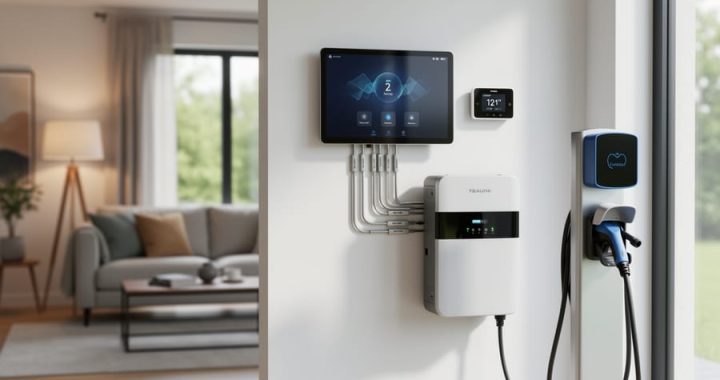
Home Energy Management Systems are integrated platforms that connect household appliances, energy generation equipment, and storage devices to a central control interface, enabling two-way communication between the home and the electricity grid. At their core, HEMS combine smart hardware, such as connected thermostats, intelligent appliance controllers, solar inverters, and battery systems, with software analytics that monitor, analyze, and automatically adjust energy use based on grid conditions, price signals, and user preferences.
The fundamental value proposition is threefold: visibility into real-time and historical energy consumption patterns, granular control over when and how devices operate, and continuous optimization that balances cost savings, comfort, and grid support. Rather than treating the home as a passive consumer of electricity, HEMS transform it into an active participant in the smart grid ecosystem. Homeowners gain actionable insights through intuitive dashboards and mobile apps, while utilities benefit from flexible load that can respond to supply-demand imbalances without compromising service quality.
This bidirectional relationship relies on standardized communication protocols and smart home control architectures that allow grid operators to send signals, such as price updates, demand response events, or frequency regulation requests, and for HEMS to execute pre-authorized actions in response. The system may shift a water heater cycle to an off-peak hour, pause EV charging during a grid stress event, or discharge battery storage to reduce peak demand charges, all while respecting user-defined constraints and comfort settings.
- HEMS (Home Energy Management System)
- A coordinated platform of hardware and software that monitors, controls, and optimizes residential energy use, generation, and storage in real time.
- Demand Response
- A grid service where consumers adjust electricity consumption in response to utility signals, typically during peak periods or supply constraints, often in exchange for financial incentives.
- Distributed Energy Resources (DER)
- Small-scale power generation or storage assets located at or near the point of use, including rooftop solar, batteries, and controllable loads.
- Time-of-Use Pricing
- An electricity tariff structure where rates vary by time of day, incentivizing consumption during off-peak hours when grid demand and costs are lower.
- Load Shifting
- The practice of moving flexible energy consumption from high-demand periods to times when electricity is cheaper or cleaner, enabled by automated scheduling in HEMS.
- Grid Edge
- The interface between the centralized electricity network and distributed assets at customer premises, where HEMS operate to coordinate local resources with grid objectives.
By integrating these capabilities, HEMS serve as the residential gateway to a more dynamic, decentralized, and efficient energy system. They bridge the gap between individual household needs and broader grid imperatives, creating a foundation for demand flexibility, renewable integration, and resilience that benefits both sides of the meter.
How Home Energy Management Systems Work
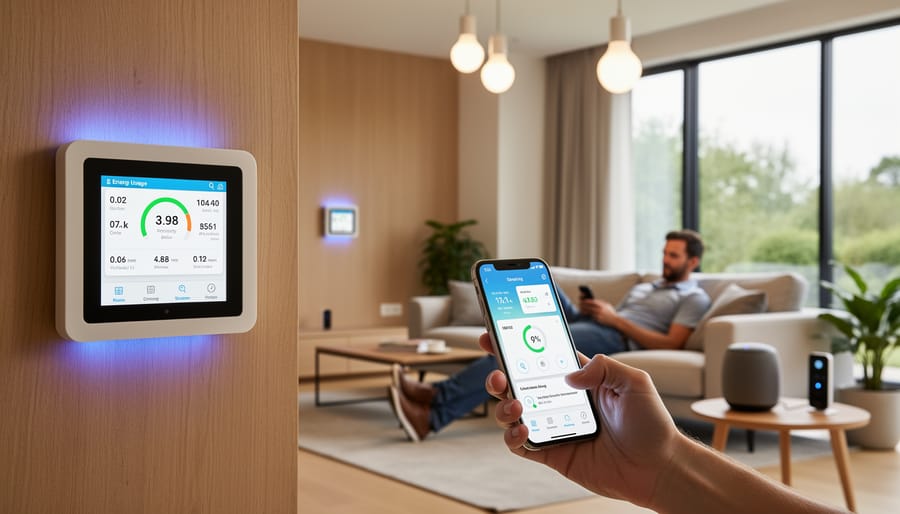
Data Flow and Real-Time Communication
At the heart of a home energy management system lies continuous, bidirectional data exchange. Smart meters serve as the primary gateway, measuring real-time consumption at intervals of seconds to minutes and transmitting this data upstream to utility servers. Concurrently, connected devices, thermostats, EV chargers, battery inverters, major appliances, stream their operational states and energy draw to an in-home hub or cloud-based HEMS platform. This data typically flows over local WiFi, Zigbee, or Z-Wave networks to a communications gateway, which aggregates and forwards it using broadband internet or cellular connections.
The platform processes this telemetry alongside external signals: time-of-use pricing, OpenADR demand response over IP messages from utilities, frequency deviations, or grid congestion alerts. Standardized protocols ensure interoperability, OpenADR 2.0b and IEEE 2030.5 are common for demand response, while IEC 61850 and Modbus may link distributed energy resources. The HEMS software evaluates these inputs against user preferences and control algorithms, then issues commands back to devices: delay a water heater cycle, discharge a battery, or adjust HVAC setpoints. Utilities simultaneously receive anonymized or aggregated load profiles and availability signals, enabling real-time demand-side management. Regulatory frameworks such as grid coding define technical requirements for this communication, ensuring that distributed assets can respond reliably to grid needs. This closed-loop architecture transforms passive consumption into an active, coordinated resource for both household optimization and system-wide stability.
Automation and Control Logic
Automation and control logic forms the intelligence layer of a home energy management system, translating raw data and grid signals into actionable device commands without requiring constant user intervention. At its core, HEMS platforms rely on scheduling algorithms that optimize energy use based on time-of-use electricity rates, user preferences, and equipment constraints. A straightforward rule might delay a clothes dryer cycle until off-peak hours when rates drop, or precool a home before a peak pricing window closes. These deterministic rules provide predictable, repeatable control but remain static unless manually updated.
Machine learning techniques add adaptive capability by analyzing historical consumption patterns, weather data, occupancy trends, and user behavior to refine control strategies over time. A learning algorithm can identify that a household consistently runs the dishwasher after dinner, predict solar generation based on seasonal cloud patterns, or recognize when occupants typically adjust the thermostat. This pattern recognition enables the system to anticipate needs and proactively optimize without explicit user input, balancing comfort with cost savings. Some platforms train models locally on edge devices for privacy and low latency, while others use cloud-based analytics to benchmark performance across thousands of homes and push refined algorithms back to individual systems.
Dynamic response to grid signals introduces real-time reactivity. When a utility broadcasts a demand response event, price spike, or frequency deviation alert via OpenADR or similar protocols, the HEMS evaluates which loads to curtail or shift based on user-defined priorities and grid severity. A critical frequency drop might trigger battery discharge or pause EV charging within seconds, while a moderate price signal could defer pool pump operation by an hour. The control logic arbitrates competing objectives, minimizing cost, maintaining comfort thresholds, preserving battery state-of-charge for backup, ensuring the home responds to grid conditions while respecting the household’s constraints and preferences.
Core Components of a Smart Grid-Enabled Home Energy System
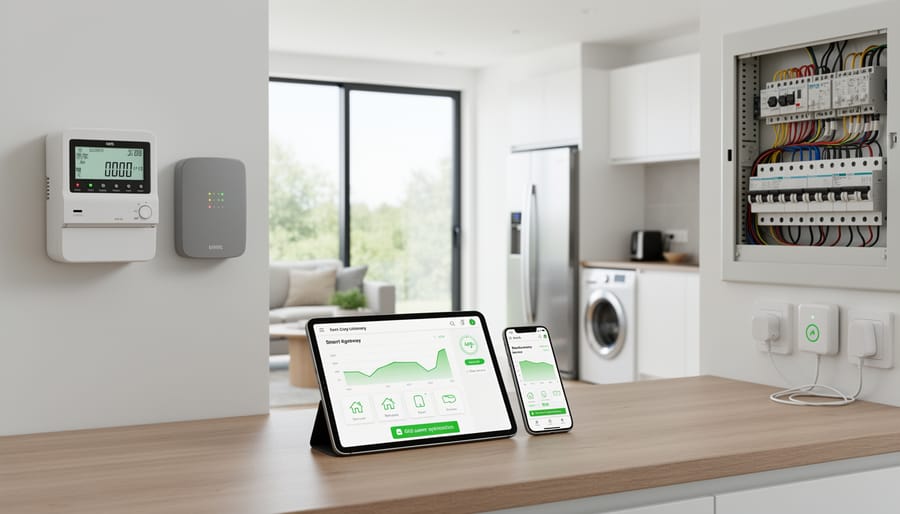
A functional home energy management system comprises several interconnected hardware and software layers, each enabling specific monitoring, control, or optimization capabilities within the residential smart grid interface.
Smart meters form the foundational measurement layer, recording granular energy consumption data at intervals ranging from seconds to fifteen minutes. Unlike legacy analog meters, these bidirectional devices communicate usage patterns, voltage quality, and outage status back to utilities while receiving time-of-use pricing signals and demand response commands. Modern solid-state meters typically support multiple communication protocols, including RF mesh networks, cellular modems, or powerline carrier systems, depending on utility infrastructure.
In-home displays and mobile applications translate raw meter data into actionable insights for occupants. These interfaces visualize real-time consumption, cost projections, historical trends, and appliance-level breakdowns when paired with circuit-level monitors. Advanced platforms incorporate predictive analytics, alerting users to anomalies such as phantom loads or aging equipment inefficiencies before they escalate into maintenance issues.
Connected thermostats represent the most widely deployed control nodes in residential HEMS deployments. These devices leverage occupancy sensors, weather forecasts, and learned behavioral patterns to optimize heating and cooling schedules, while integrating with utility demand response programs that temporarily adjust setpoints during grid stress events. Similar logic extends to smart water heaters, which shift heating cycles to off-peak hours without compromising comfort.
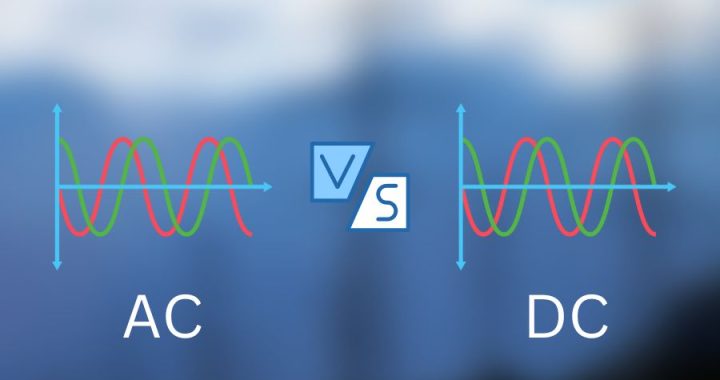
Distributed energy resource components introduce bidirectional energy flows. Solar inverters convert DC panel output to grid-synchronous AC while providing performance telemetry and grid support functions like reactive power injection. Battery storage systems, configured through AC vs DC coupling architectures, enable time-shifting of solar generation, backup power provision, and arbitrage of time-varying electricity rates. EV chargers with smart capability modulate charging rates based on vehicle departure schedules, electricity prices, and available renewable generation or grid capacity.
Communication gateways aggregate data streams from heterogeneous devices using protocols like Zigbee, Z-Wave, Wi-Fi, or Thread, translating them into standardized formats such as IEEE 2030.5 or OpenADR 2.0b for utility system interoperability. Cloud platforms or local edge controllers execute optimization algorithms, manage device coordination, and enforce user preferences across the ecosystem.
Interoperability standards remain critical to preventing vendor lock-in and ensuring system scalability as new technologies emerge. Certifications under programs like Energy Star Connected and compliance with IEEE, IEC, or ASHRAE guidelines enable seamless integration across manufacturers and utility programs.
Applications and Use Cases in Everyday Home Energy and Maintenance
Demand Response and Grid Services
Homeowners can enroll in demand response programs offered by their utility, granting the HEMS platform permission to adjust select loads during grid stress events, typically hot summer afternoons when air conditioning demand peaks or during supply shortfalls. When the grid operator issues a demand response signal, the HEMS might raise the thermostat setpoint by two degrees, delay a dishwasher cycle, or temporarily pause EV charging. These adjustments are often imperceptible to occupants yet aggregate across thousands of homes to create meaningful load relief, avoiding the need for peaker plants or emergency imports.
Utilities compensate participants through bill credits, fixed capacity payments, or per-event incentives. Incentives for peak reductions vary by program design but can range from a few dollars per event to hundreds annually for households willing to provide deeper or more frequent load curtailments. Beyond direct financial rewards, participation contributes to grid stability by flattening demand spikes, reducing transmission congestion, and deferring costly infrastructure upgrades.
Advanced HEMS platforms enable homeowners to set participation thresholds, defining which devices can be controlled, under what conditions, and for how long, ensuring comfort preferences remain respected. Some programs also support manual overrides, allowing users to opt out of individual events if circumstances change, maintaining consumer autonomy while delivering grid-side flexibility.
Integration with Distributed Energy Resources
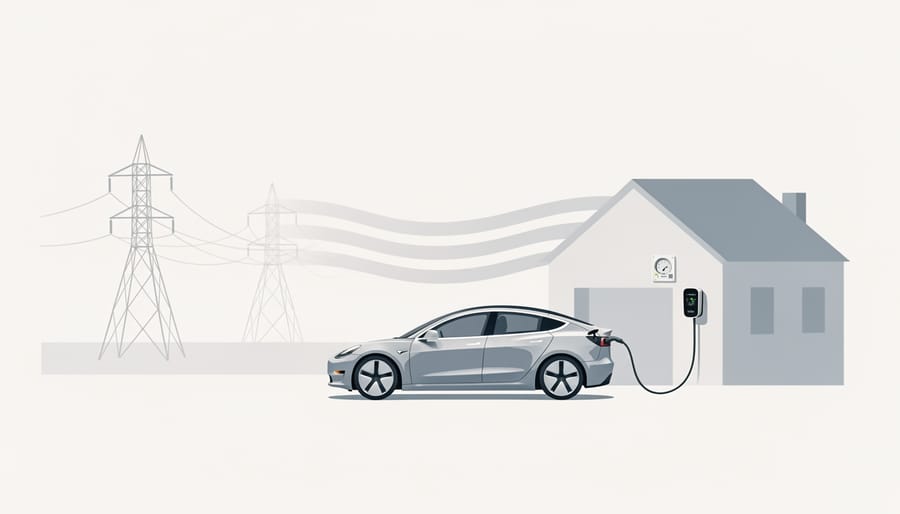
Home energy management systems excel at orchestrating distributed energy resources to maximize economic and environmental value. When a household has rooftop solar panels, battery storage like the Tesla Powerwall and an electric vehicle with bidirectional charging capability, the HEMS becomes the central intelligence layer that decides when to consume, store, export, or discharge energy based on real-time conditions.
The platform continuously evaluates multiple variables: solar generation forecasts derived from weather data and historical patterns, battery state of charge, household load profiles, time-of-use electricity rates, grid frequency signals, and any contracted demand response or ancillary service commitments. During midday solar peaks, the system prioritizes self-consumption first, powering immediate household needs, then charges the battery to meet evening demand, and finally exports surplus to the grid if net metering or feed-in tariff rates are favorable. Conversely, during evening peaks when retail electricity prices spike or the grid issues a demand response event, the HEMS can discharge stored battery energy to offset expensive grid imports, or even enable vehicle-to-home (V2H) or vehicle-to-grid (V2G) export if the EV is plugged in and the owner has enrolled.
Advanced HEMS platforms can bid battery capacity into wholesale markets for frequency regulation or reserve services, providing millisecond-level response to grid operators while earning revenue for the homeowner. This stacking of value streams, bill savings, export revenue, and grid service payments, transforms static assets into active grid resources. The technical complexity of managing state-of-charge windows, cycling limits, and communication protocols is abstracted behind automated algorithms, making sophisticated energy arbitrage accessible to residential users without manual intervention.
Benefits for Homeowners and the Grid
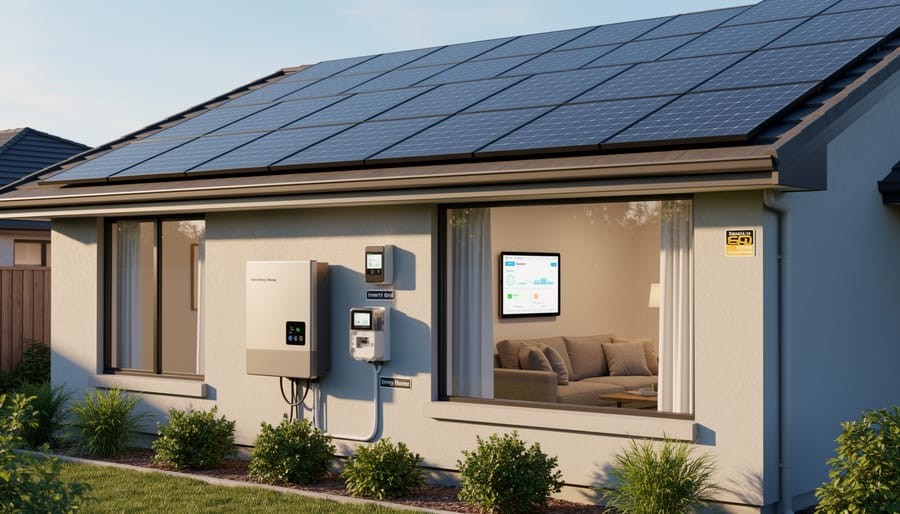
Home energy management systems create value for both residential users and the broader electricity grid, establishing a symbiotic relationship that drives the energy transition forward. For homeowners, the most immediate benefit is cost reduction through automated optimization of energy consumption patterns, particularly under time-of-use tariffs where electricity prices vary by hour. Systems can shift discretionary loads like water heating, pool pumps, and EV charging to periods when grid electricity is cheapest, typically overnight or during midday solar abundance, routinely delivering 15-30% reductions in monthly bills without sacrificing comfort. Beyond savings, HEMS platforms provide unprecedented visibility into household energy flows, enabling informed decisions about appliance replacement, insulation upgrades, and behavioral adjustments that compound efficiency gains over time.
Enhanced comfort and convenience represent another consumer advantage, as intelligent automation learns household routines and preferences to maintain optimal temperature, lighting, and air quality without constant manual intervention. Homeowners with solar panels and battery storage gain greater energy independence, maximizing self-consumption of locally generated power and reducing reliance on grid electricity during peak rate periods or supply constraints. The sustainability dimension resonates strongly with environmentally conscious consumers: HEMS facilitates deeper integration of renewable energy, lowers carbon footprints through efficiency improvements, and empowers households to actively participate in grid decarbonization efforts rather than remaining passive consumers.
From the utility and grid operator perspective, residential HEMS deployment provides critical demand-side flexibility that has historically been difficult to access at scale. Aggregated participation in automated demand response programs allows operators to modulate residential load during peak stress events, effectively creating a virtual power plant that can defer or eliminate the need for expensive peaking generation capacity and transmission upgrades. This load flexibility proves particularly valuable for integrating variable renewable generation: when wind and solar output surge beyond instantaneous demand, HEMS can absorb excess energy through opportunistic EV charging or battery storage, smoothing supply-demand imbalances without curtailment. Enhanced grid resilience emerges as distributed energy resources coordinated through HEMS can provide backup power during outages, support voltage regulation, and contribute frequency response services that stabilize the network. These collective benefits lower system-wide costs, reduce carbon emissions intensity, and create a more adaptive, decentralized grid architecture capable of accommodating the bidirectional energy flows that characterize modern electricity systems.
Challenges and Considerations
Despite their potential, home energy management systems face a set of technical, economic, and institutional challenges that slow widespread adoption. Understanding these barriers is essential for stakeholders working to accelerate deployment and for homeowners evaluating whether to invest.
Interoperability remains one of the most persistent hurdles. The residential energy technology landscape is fragmented across dozens of manufacturers, communication protocols, and proprietary platforms. A smart thermostat from one vendor may not communicate seamlessly with a battery system from another, and integrating these devices into a unified HEMS often requires specialized gateways or middleware. While industry groups are advancing standards like IEEE 2030.5 and OpenADR, full plug-and-play compatibility is not yet the norm. This fragmentation increases installation complexity and limits the value homeowners can extract from their investments.
Cybersecurity and data privacy concerns loom large as more household systems connect to the internet and exchange granular consumption data. HEMS platforms collect real-time information about when occupants are home, which appliances they use, and how much energy they consume, creating potential vectors for surveillance or cyberattacks. Robust smart grid identity management and encryption protocols are critical, but many legacy devices lack strong security features. Utilities and vendors are working to implement defense-in-depth architectures and transparent data governance policies, yet consumer wariness persists.
- Device compatibility across manufacturers and protocols
- Data security vulnerabilities and privacy exposure
- Initial investment costs and installation complexity
- Low consumer awareness and engagement
- Rate structures that do not reward flexibility
- Regulatory uncertainty and policy gaps
Upfront cost and complexity deter many potential adopters. A full HEMS deployment, including smart meters, thermostats, battery storage, and professional installation, can run into thousands of dollars. While operational savings and demand response incentives offset these costs over time, the payback period may exceed five years, particularly in regions with flat electricity rates. Simplifying installation and reducing hardware costs through mass production and integrated product bundles are industry priorities.
Consumer engagement and education gaps compound these technical challenges. Many homeowners lack awareness of time-of-use rates, demand response programs, or the capabilities of their connected devices. Even when systems are installed, low engagement with dashboards and control interfaces limits optimization. Utilities and equipment vendors are investing in intuitive user experiences and automated operation to minimize the need for active management.
Regulatory and tariff design issues also hinder progress. In many jurisdictions, rate structures do not sufficiently differentiate between peak and off-peak pricing, reducing the financial incentive for load shifting. Interconnection rules for distributed resources can be cumbersome, and demand response compensation mechanisms vary widely. Policymakers are increasingly recognizing these barriers and piloting reforms, but alignment across states and regions remains uneven. These challenges are significant, but they represent areas of active development rather than fundamental roadblocks, with momentum building across the industry to address each systematically.
Frequently Asked Questions
Do I need special equipment to use home energy management systems?
Most HEMS require a smart meter (typically provided by your utility), a home gateway or hub to coordinate devices, and compatible smart appliances, thermostats, or distributed energy resources such as solar inverters and battery storage. Many newer homes come with some of these components pre-installed, while retrofit solutions are available for older properties.
How much money can I realistically save with a HEMS?
Savings vary widely based on your utility’s rate structure, baseline consumption, and participation in demand response programs. Households with time-of-use rates and automated load shifting can see reductions of 10 to 30 percent on monthly bills, while those integrating solar and storage may achieve greater independence from grid electricity purchases.
Is my energy data secure, and who has access to it?
Reputable HEMS platforms employ encryption, secure authentication, and data anonymization to protect your information. Utilities and third-party providers are typically bound by privacy regulations, but review your service agreements and opt-in consent forms to understand what data is shared and with whom.
What happens to my HEMS during a power outage?
If you have battery storage with backup capability, critical loads can continue to operate and your HEMS may coordinate energy flows to prioritize essential devices. Without storage, the system relies on grid power and will be offline until service is restored, though some gateways retain scheduling data for a seamless restart.
Renters face unique constraints but are not entirely excluded from HEMS benefits. Portable smart plugs, programmable thermostats, and third-party energy monitoring apps require no permanent installation and can deliver visibility and modest control without landlord approval. For deeper integration, such as participating in utility demand response programs or installing smart panels, you will need property owner consent and may have limited ability to recoup upfront costs if you move. Some utilities offer renter-friendly programs that provide loaner devices or incentives tied to the account rather than the property, making short-term participation feasible.
Enrolling in demand response programs typically begins with your utility’s website or customer portal, where you can browse available offerings and check eligibility. Registration often involves providing account details, selecting participation options, and confirming that you have compatible smart devices or agree to manual event response. Once enrolled, the HEMS platform or utility system will send signals during peak events, and your automated devices adjust load accordingly, earning you bill credits or direct payments for your flexibility.
Home energy management systems represent far more than a collection of smart devices, they are the critical interface through which individual households participate in the transformation of the electric grid. As utilities, grid operators, and policymakers work to integrate higher shares of variable renewable generation, manage peak demand, and build resilience against climate-driven disruptions, the coordination and flexibility offered by millions of connected homes becomes essential infrastructure, not optional technology.
The trajectory is clear: residential energy systems will grow more integrated, responsive, and automated. Advances in machine learning will enable HEMS platforms to anticipate household patterns and grid needs with greater precision. Interoperability standards will mature, reducing friction between devices and systems. Battery costs will continue falling, making energy storage accessible to broader segments of homeowners. Vehicle-to-grid capability will turn EVs into mobile storage assets. These technical improvements, however, must be matched by supportive policy frameworks, tariff structures that reward flexibility, streamlined interconnection processes, data governance that protects privacy while enabling innovation, and programs that extend benefits beyond early adopters to underserved communities.
The vision of a decarbonized, resilient, and efficient energy system depends on active consumer participation. Homeowners who understand and engage with these systems unlock value for themselves and contribute to collective grid stability. The transition requires continued collaboration across technology providers, utilities, regulators, and end users to realize the full potential of home energy management within the smart grid.